Last updated: January 31, 2024
Cell phone and texting news: State Sen. Shelley Mayer has proposed a two-year pilot program for field testing of the so-called “textalyzer” technology. The study envisioned by S2687 would be in Westchester County. The Governor’s Traffic Safety Committee also has the technology under study. Gov. Andrew Cuomo said the panel will report back on “the effectiveness of using this emerging technology to crack down on this reckless behavior and thoroughly evaluate its implications.” Three public forums were held on the issue. The textalyzer, developed by an Israeli company, would allow police to scan a cell phone to tell if was in use just before a crash without revealing personal information.
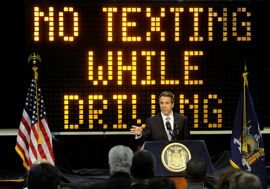 At least a dozen distracted driving bills have been filed for the 2019-20 legislative session. Plans ported over from previous sessions include a ban on any use of cell phones by novice drivers; a requirement that cell phone makers automatically halt texting functions in moving vehicles; a field test program for possible cell phone use during accidents; and establishment of a general inattentive driving law.
Current distracted driving laws
- Drivers must use hands-free devices while talking on cell phones.
- Text messaging and related uses of handheld electronic devices banned.
- Taxi cab drivers in New York City banned from using cell phones.
- Television screens not allowed within view of drivers.
New York state distracted driving fines:
- First offense: $50 to $200.
- Second offense (within 18 months): $50 to $250.
- Third offense (within 18 months): $50 to $450.
- Five demerit points for all violations (effective 2015).
- Read the New York regional distracted driving news & laws page.
(text continues)
Recommended Gear to help prevent distracted driving
Universal Dashboard Windshield Suction Cup Holder for Smartphones
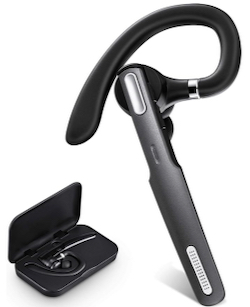
Wireless Bluetooth Earpiece V5.0 Hands-Free Earphones
Bluetooth Headset Wireless with Battery Display Charging Case
“A Deadly Wandering” Distracted Driving Book
(Amazon affiliate links/ads)
Cell phone & texting legislation (2019-20):
Senate Bill 1119: Would require portable electronic devices sold after January 2022 to automatically disable texting and computer functions when the holder is operating a motor vehicle over 10 miles an hour. (Lanza)
S1892: Seeks to prohibit drivers of school buses from using hands-free cell phones. (Gallivan)
S2687: Would establish a two-year pilot program for field testing of mobile phones and portable devices via “textalyzer” or similar scanner for the county of Westchester. Would determine if cell phone was in use at time of crash. Approved by Transportation Committee in a 10-1 vote of April 30. (Mayer)
S2980: Would prohibit use of a hands-free mobile telephone by operators of motor vehicles who hold a learner’s permit or a class DJ or MJ license. (Gaughran)
S5392: Would allow local police departments to field test cell phones after crash, using scanning devices. (Griffo)
S5746: Would prohibit a pedestrian from using a portable electronic device while crossing a roadway. Fines from $25 to $250. (Liu)
Assembly Bill 1516: Texting & walking bill. Same as S5746, above. (Ortiz)
A2435: Proposes a general inattentive driving statute. Outlaws distraction via “non-driving activities.” Establishes “Attentive Driver Education Fund.” (Gantt)
A3083: Would bar use of head-mounted portable electronic devices while driving. (Oritz)
A3087: Seeks to expand definitions of vehicular assault in the first degree, vehicular assault in the second degree and reckless driving to include offenses involving use of a portable electronic device while driving. (Oritz)
A3201: Scanning of cell phones. See S5392, above. (Ortiz)
A3815: Would include mobile phone driving violations in vehicular manslaughter and vehicular assault punishments. (Ortiz)
A6417: Would direct DOT and Governor’s Safety Committee to study use of Internet-enabled glasses and contact lenses. Bars use of these devices while driving until studies are completed. (Crespo)
A7267: Westchester “textalyzer” study. See S2687, above. (Paulin)
2017-18 cell phone & texting legislation:
Assembly Bill 1291: General inattentive driving law. Cites “non-driving activities” that interfere with proper use of roadways or endanger others. Fines: $50 to $150 (first offense), then $150 to $250 (within six months of first offense). Three convictions with 18 months means a reckless driving offense. Fines would be routed to new “Attentive Driving Fund” for distracted driving education. See A229 of 2015, below. (Gantt)
Senate Bill 330: Would make use of a cell phone or similar device while driving with a child 15 years old or younger a misdemeanor. Fines: $150-$500 with possible jail time. (Murphy)
S1173: Would prohibit operation of a motor vehicle if it is equipped with a display device within the view of the operator. Approved by the full Senate in a unanimous vote of June 14. See S457 of 2015, below. (Marcellino)
S1257: Would prohibit use of a hands-free mobile telephone by drivers with a learner’s permit or a class DJ or MJ license. Approved by the full Senate in a 62-1 vote of June 20. See S383 of 2015, below. (Marcellino)
S1261: Would consider a motor vehicle in motion while stopped at traffic control devices and stop signs for purposes of mobile phones and other portable electronic devices. Approved by the full Senate in a 62-1 vote of June 20. See S731 of 2015, below. (Marcellino)
S2306: Would provide for the field testing for use of mobile telephones and portable electronic devices while driving after an accident or collision. Approved by Transportation in a unanimous vote of March 21.(Murphy)
S478: Would require New York City Department of Transportation to develop pedestrian education campaign about dangers of using mobile phones while while crossing an intersection and/or walking in or near a street. Approved by the full Senate in a 60-2 vote of June 7. Approved by the House on June 20. (Peralta)
A3955: See S2306, above. (Mayer)
2018 distracted driving notes:
A swarm of previously unsuccessful distracted driving measures were under consideration in the 2017-18 legislative session. Plans ported over from the previous session include enhanced punishments for those who use handheld devices while transporting a child in the vehicle; a ban on any use of cell phones by novice drivers; a field test program for possible cell phone use during accidents; and establishment of a general inattentive driving law.
2017 distracted driving notes:
At least 205,213 tickets were handed out statewide for distracted driving during 2016, the governor’s office reports. Texting & driving tickets have soared 918 percent since 2011, officials said.
State Sen. Terrence Murphy’s bid to clear the way for “textalyzer” tests of cell phones didn’t get far in the 2017 session. He says the device’s use is inevitable, however: “It’s not if, it’s when,” Murphy told the AP. “This will literally save lives.” The Governor’s Traffic Safety Committee report on the textalyzer will address civil liberty concerns.
The governor’s office seeks to close a loophole in New York’s current distracted driving laws that allows motorists to use their handheld electronics while temporarily stopped in traffic — as in waiting at a red light. Gov. Andrew Cuomo also seeks to prohibit use of electronic devices by drivers under the age of 18. The proposals are part of the State of the State Book for 2017. A state Department of Motor Vehicles spokesman called the traffic-stop plan a “common sense measure” that would “close a glaring loophole.” State Sen. Carl Marcellino’s similar plan was approved by the Senate in 2017 (above).
2015-16 cell phone & texting legislation:
A229: Would make engaging in certain non-driving activities while driving inattentive driving. Three violations during an 18-month period becomes reckless driving. Fines: $50 to $150, then $150 to $250. Fines would be routed to new “Attentive Driving Fund” for distracted driving education. (Gantt)
A3490: Would prohibit display via video monitor of TV or video in moving vehicle, within view of driver. Exempts motor homes. This amends and updates current ban on “television receiving sets.” (Wright)
A4879: Would outlaw use of head-mounted and wearable portable electronic devices while driving. Cites Google Glass. (Ortiz)
A8613: Would allow field testing for use of mobile telephones and other wireless communications devices while driving after an accident or collision. Establishes “implied consent” to use of “electronic scanning devices.” aka Evan’s Law. (Ortiz)
S383: Would prohibit use of a hands-free mobile telephone by drivers with a learner’s permit or a class DJ or MJ license. (Marcellino)
S384: Wearable electronics bill. See A4879, above. (Marcellino)
S457: Would prohibit operation of a motor vehicle equipped with a display device within the view of the operator. (Marcellino)
S731: Would bar use of portable communications devices by drivers stopped at red lights and stop signs. (Marcellino)
S6325: Same as A8613, above. (Murphy)
2016 distracted driving notes:
Ticketing for cell phone use by New York drivers continues to decrease, but texting & driving citations are hitting a peak. Texting tickets “have dramatically increased each year since 2011,” according to the governor’s office. In 2015, there were a combined 216,748 distracted driving tickets handed out, down from 242,000 the year before.
Legislation for 2016 seeks to establish roadside scans for mobile phones after crashes. The scans would determine whether the phones have been used, but would not access content. The process would run on “implied consent” by drivers. Those who refuse to surrender their communications devices for roadside analysis would have their licenses suspended. The twin bills come from Assembly member Felix Ortiz and state Sen. Terrence Murphy. Ortiz said he was “very optimistic” they could get the plan approved by session’s end in June, but no votes were recorded.
The proposed scanning of electronic devices after crashes (under A8613) would come under “Evan’s Law,” named for Westchester County student Eric Liberman, who died in a 2011 wreck linked to cell phone use. Liberman’s family reportedly is working with Israeli company Cellebrite to develop the technology, dubbed the “textalyzer.”
New York drivers received 132,028 tickets for cell phone use in 2015, down from 165,087 the year before. Texting & driving tickets increased to 84,720 (vs. 76,212 in 2014). There has been an 840 percent increase in tickets for texting in New York State since 2011, the governor’s office said. It cited “the proliferation of smartphones.”
2015 distracted driving notes:
A handful of distracted driving bills are before the New York Legislature in 2015. They include a general “inattentive driving” ban that seeks reckless driving convictions for serial offenders; an update of the prohibition on drivers viewing television signals; and several “Google Glass”/wearable technology driving bills.
New York is running a distracted driving sweep April 10-15, targeting those who use handheld devices while behind the wheel. Unmarked vehicles will be employed, the governor’s office said. The November sweep yielded about 500 tickets. “State troopers will not hesitate to give tickets to drivers” who ignore the law, Police Superintendent Joseph D’Amico said. The crackdown is part of Distracted Driving Awareness Month.
2014 distracted driving notes:
Young and inexperienced drivers face tougher punishments for texting or using a cell phone in New York. As of Nov. 1, 2014, drivers with a probationary license, Class DJ, Class MJ or a learner permit who violate electronic distracted driving laws face a mandatory 120-day license suspension. Second-time offenders (within six months of license restoration) will see a minimum one-year loss of driving privileges.
The revised road laws, passed as part of the budget, also see increases in penalties for electronic distracted driving, from a minimum of $50 to $200 maximum (first offense). For a second offense (with a year and a half), the top fine is $250. Three-time offenders top out at $450. Those increases, which apply to all drivers, also took effect Nov. 1, 2014.
The Nassau County district attorney has called on the makers of cell phones to provide “kill switches” that prevent texting and driving. DA Kathleen Rice says she’ll recommend to the sentencing court the use of these devices in any case involving a texting violation. “There will be a specific plea program for young drivers that employs these devices pre-sentence to allow the young driver to earn a reduction in the charge and sentence,” the District Attorney’s Office recommended in early September. Rice also called on insurance companies to provide discounts for those who employ the anti-texting technologies. Rice, who previously campaigned against drunken driving, is running for Congress.
“Too many times we have witnessed the tragedy that comes as a result of texting while driving,” Gov. Andrew Cuomo said in response to news that texting ticketing had soared in 2013. “The continued vigilance against this destructive behavior should send a resounding message to all drivers: Keep your eyes on the road and your hands on the wheel.”
Distracted driving ticketing was up 82 percent in 2013. The boom in citations an be credited in large part to Cuomo, who remains on the warpath against distracted driving.
“I thank the State Police and local law enforcement for their dedication to making this a safer New York,” Cuomo said Jan. 31, in response to a Gannett report about the ticketing. Police handed out about 55,000 texting tickets in 2013, up from about 30,000 in 2012. Cell phone tickets were put at 207,000, a drop from 217,000 in 2012.
Via executive order, Cuomo increased the DMV points against a driver convicted of text messaging or using handheld cell phones from 3 to 5 points.
Read more about Cuomo’s latest distracted driving crackdowns.
In almost half of New York’s counties, the number of text & driving tickets doubled in 2013, Gannett reported. The counties included in Westchester, Rockland, Dutchess and Broome.
2013 distracted driving notes:
New York’s distracted driving regulations for drivers with commercial licenses went into effect in late October, bringing the state into alignment with federal DOT rules. Many states adopted local statutes since early 2012 in order to protect highway funding. The move is “another example of how the message is being sent that texting or using a cell phone while driving will not be tolerated in New York state,” DMV Commissioner Barbara Fiala said.
The governor’s office says New York’s summerlong crackdown on distracted driving has continued into fall: Since July 4, 2013, State Police handed out almost 28,000 tickets to distracted drivers.
Not surprisingly, Gov. Cuomo rolled out for National Teen Driver Awareness Week: “Motor vehicle crashes are the No. 1 killer of 16- to 24-year-olds, and the majority of crashes occur during the first six months of licensed driving,” the governor said in supporting the national awareness campaign Oct. 21. “That is why it is our responsibility as parents and guardians to instill safe driving habits in our teens who are just getting behind the wheel and why New York State recently increased penalties for distracted drivers, with a focus on new drivers.”
The governor signed the teen driver legislation July 1, saying the new law “sends a powerful message to our young and new drivers that texting while driving will not be tolerated here in New York state.” As of January 2013, there were 331,000 drivers between the ages of 16 to 19 in New York.
Under the law, young drivers who illegally text message will be hit with the same penalties they now face for reckless driving. That means a driver with a restricted license would face a 60-day suspension for a first conviction of texting, while subsequent offenses within six months draw revocations of 60 days (for junior licenses) or 6 months (for probationary licenses).
Over the long July 4 weekend, State Police wrote 486 tickets for texting and cell phone use. By mid-October, the number of tickets written since the summer crackdown began July 4 hit almost 28,000.
Gov. Cuomo ordered his New York State Police to crack down on distracted driving throughout the summer. As part of the effort, the state deployed more “spotter” SUVs, with high passenger seating that allows officers to see drivers who are using handheld devices.
“No parent should have to experience losing a child at the hands of a text message,” the governor said at a news conference announcing the crackdowns and new teen driver legislation.
“As the father of three teenagers, I know firsthand the importance of instilling safe practices in our young drivers who are developing lifelong habits as they learn to navigate the road,” Cuomo said. “Inattention and inexperience is a deadly combination.”
At least one state senator has reservations about Gov. Andrew Cuomo’s use of executive orders to assign additional points against distracted drivers’ licenses. The governor crosses a “very fine line without engaging the Legislature,” state Sen. Peter Lopez told Hudson-Catskill Newspapers on July 1. “Does the DMV have the authority to take somebody’s license without any real public process?” The governor’s office replied that “points are usually done by regulation.”
New York’s state Legislature is among the first to consider a total ban on cell phone use while driving. The bill was filed for the 2013-14 session by longtime distracted driving opponent Assemblyman Felix Ortiz.
A bill that specifies use of handheld wireless communications devices is illegal while temporarily stopped in traffic is advancing in the Senate.
Convictions for text messaging & driving in New York are lagging successful cell phone prosecutions, with only 44 percent of all texting tickets since 2009 leading to convictions, state records show. About 82 percent of tickets for handheld cell phone use between 2001 and May 2013 led to convictions, according to a Gannett analysis of DMV records. In 2012, the texting percentage rose to 66 percent, the report said. But ticket challenges quite likely will rise with the increase in points attached to distracted driving convictions, the June 9 report said.
Police wrote 30,166 texting & driving violations during 2012. That’s a 234% increase in the number of tickets issued compared with 2011, when the offense became subject to primary enforcement. New York County saw the most citations, followed by Monroe County.
Assemblyman Felix Ortiz’s plan for a total talking & driving ban is unusual, but one that’s in line with the National Transportation Safety Board’s 2011 recommendation of total cell phone bans. Noting that New York was the first state to ban use of handheld cellular telephones while driving, Oritz says the state “must continue to be a leader in implementing measures to ensure the utmost safety of its citizens — and that is why New York must ban all use of cellular telephones while driving.”
Ortiz filed three other pieces of distracted driving legislation in addition to the one seeks a total cell phone ban: One seeks to outlaw the dialing of handheld cell phones while driving, another seeks to apply criminal penalties to drivers who kill or cause serious injury while talking on a phone, and the third would require police to detail cell phone use while writing accident reports.
A Queensbury woman has been sentenced to four years in prison for hitting and killing another woman while using a cell phone. The victim’s family asked for the maximum possible sentence in the negligent homicide case, and the judge agreed, handing down a 1 1/3 year to 4 year prison term on March 28. Deana Olsen, 36, killed Terry Brownell, 48, as she mowed her lawn in Kingsbury. The judge said he was “shocked and outraged” by Olsen’s claims she too was a victim. Olsen cried as the judge found her guilty in February, but a relative of the dead woman said, “It’s a little late.”
Assemblyman Felix Ortiz, sponsor of four distracted driving measures for the 2013-14 session, has numerous pieces of legislation addressing the problem since 1996. He was a key sponsor of the 2000 legislation that resulted in New York’s handheld cell phone ban for drivers. Ortiz, D-Brooklyn, seeks “to put an end to such senseless accidents and to keep our highways safe.”
The Monroe County Sheriff’s Office says it has so many complaints about distracted drivers that its web site now includes a report form. No one actually gets a ticket, but the alleged violators do receive a warning letter.
2013-14 cell phone & texting legislation:
Senate Bill 5656: Provides for 60-day suspensions for probationary and junior license holders who violate the state’s electronic distracted driving laws. A subsequent offense (within six months) would result in revocation of a a probationary license for six months and a junior license for 60 days. Per governor’s request. Approved by the Senate and Assembly on June 5. Signed into law by the governor on July 1. (Marcellino)
Assembly Bill 7739: Same as S5656, above. Approved by the Assembly on June 5. (Hennessey)
S3718: Would specify that the state texting & handheld cell phone laws apply when vehicles are stopped at stop signs, traffic lights, railroad crossings or due to heavy traffic. Approved by the Senate Transportation Commitee in a 12-6 vote of April 30. Advanced to third reading on Senate floor. (Marcellino)
A3022: Would ban use of cell phones while driving, with the only exemption being calls seeking emergency assistance. No hands-free provision. Fine: up to $100. (Oritz)
A2668: Would ban display of video in front seat area of a vehicle, within view of the driver. Includes “prerecorded programming” for entertainment or business purposes. GPS and navigation screens exempted. Same as A4514 of 2011-12. (Wright)
A2884: Seeks to prohibit the “dialing” of mobile telephones by drivers. Would rewrite and replace existing state law to add dialing to definition of “using” a cell phone. (Oritz)
A1963: Would require police to indicate on accident reports whether a cell phone was in use at the time of the incident. (Oritz)
A2570: Seeks criminal penalties for drivers who, while using a cell phone, kill or injure another person. Would apply same penalties as for drivers who are under the influence. Two points against license in addition to other penalties, which could include prison time. (Oritz)
2012 distracted driving notes:
The number of texting tickets written in New York quadrupled in the year since the state cracked down on drivers distracted by portable electronic devices, officials said.
More than 20,000 tickets were written in the 12 months following July 12, 2011, Gov. Andrew Cuomo announced on the first anniversary of New York’s tougher distracted driving laws.
“The major increase in (texting) tickets … demonstrates (increased enforcement’s) usefulness in helping our law enforcement authorities crack down hard on distracted driving,” said Cuomo, top left.
In the year before the law was passed, New York law enforcement officials issued 4,569 texting tickets. (View a chart comparing texting ticketing in New York counties.)
A second Operation Hang Up crackdown on drivers who use handheld cell phones and text message ran April 23-29. Gov. Cuomo promoted the sweep with news that 150 drivers were stopped and cited in the first 12 hours. Cuomo also reported April 24 that more than 65,000 motorists have been busted for using handheld electronic devices so far in 2012.
Cuomo promoted the second federally funded Operation Hang Up during an April 24 appearance with safety groups in Battery Park City. “We hear too many heartbreaking stories about how distracted driving leads to tragic consequences, and we must do everything in our power to ensure more lives are not unnecessarily lost because someone took their eyes off the road to use a phone.”
New York state’s text messaging ticketing soared in the seven months since tougher enforcement of electronic distracted driving laws began in July 2011. Overall, law enforcement officers wrote almost 120,000 electronic distracted driving tickets July 12, 2011, to Feb. 7, 2012. Text messaging violations saw the most significant increase, to 7,495 tickets.
2011 distracted driving notes:
In 2011, there were 25,165 fatal and personal injury crashes involving distracted driving in New York, state officials said.
On July 12, 2011, Cuomo signed the get-tough legislation that upgraded enforcement of the texting while driving law to primary status. The governor also used administrative means to add another point against the licenses of distracted drivers.
The successful Assembly and Senate legislation removed the secondary enforcement status from the state’s text-message ban on drivers. The new law does not increase penalties for violators ($150), just increases the chances of their being pulled over and cited. It took effect immediately.
Cuomo’s third point applies to handheld cell phone violators, who are already targeted for primary enforcement (meaning police do not need another reason to stop and cite them).
New Yorkers who text and drive became subject to 2-point penalties in 2011. The rule change, effective Feb. 16, 2011, brings handheld cell phone violations in line with penalties under the state’s 2009 text messaging law.
The first full month under the state’s newly toughened distracted driving laws (August) yielded a record 1,082 tickets for texting, the DMV said. Year to date, more than 4,600 texting tickets have been written, already well above 2010’s total of 3,250.
With primary enforcement, the number of texting tickets more than doubled in 33 counties, Gannett reported, and more than tripled in a few other counties. (Cell phone tickets were in line with 2010 numbers.)
“I am proud to sign this bill today, both as the governor and as a father of three teenagers,” Gov. Cuomo said as he signed the tougher text messaging plan into law. “It’s plain and simple: distracted driving leads to tragedies that have affected families all across New York. This new law will help ensure that drivers keep their eyes on the road and their hands on the wheel. I thank Sen. Marcellino and Assemblyman Weisenberg for their hard work on this legislation.”
Cuomo decided to add the third point to distracted driving infractions at the administrative level because his plan did not advance in the Legislature.
Assemblyman Harvey Weisenberg, sponsor of A8106, said he received a congratulatory phone call from the governor’s office upon its passage, despite the presence of the competing measure from Cuomo. “I’m not going to kill our bill just because the governor came out with a recommendation,” Weisenberg, D-Nassau County, told the Legislative Gazette.
The sponsors of the primary-enforcement measure that passed the House and Senate — Weisenberg and Sen. Carl Marcellino — are the authors of similar measures introduced earlier in the session, including one that passed the Senate (SB 998b).
Weisenberg vowed to either get the bill through the Assembly or walk out. “We need tougher measures to crack down on texting while driving, and (to) send the message that our loved ones’ lives are simply not worth this unnecessary risk,” he said at a May 3 press conference just before the Senate approved S998b. Weisenberg sponsored the companion bill A6174.
Both the governor’s plan and the legislature’s plan would require distracted driving materials added to driver education courses.
S998 sponsor Sen. Marcellino, R-Syosset, said just before the vote: “Texting and driving is the ultimate distraction, taking all focus and attention off the road. The lethal nature of this epidemic mandates that we pass the primary ban now.”
Numerous city and county legislators have pushed for tougher local laws, pointing to the state law’s secondary enforcement. (View New York regional texting and driving legislation.)
Syracuse’s federally funded crackdown on distracted drivers ended April 16, with about 1,550 tickets written in the fourth, concluding sweep.
Syracuse’s revenues from distracted driving tickets issued in the four 2010-2011 sweeps totaled more than $400,000 as of August 2011, the Post-Standard reports. The majority of the funds came in surcharges attached to the tickets, which numbered 9,352. Money is still being collected as outstanding cases are settled.
The last of Syracuse’s federally funded distracted driving sweeps yielded 1,553 citations during its run April 7-16. “Understand, there will be a zero tolerance policy,” state police Maj. Donald DePass said at an opening press conference. “No excuses, no exceptions. We will continue to do enforcement until everyone gets it.” The breakdown: 1,371 for handheld cell phone violations; 182 for texting or using another electronic device.
The $300,000 program began in April 2010 and ended in April 2011. Law officers came from across Onondaga County and got overtime for their participation (more below).
The New York DMV commissioner says the Syracuse crackdown is a model program that could work statewide and nationwide. DOT chief Ray LaHood has praised the sweeps as a model for preventing distracted driving injuries and deaths.
2011 legislation:
A8106: Seeks to apply “primary enforcement” to New York’s texting while driving law. Introduced June 1. Approved by the Senate and Assembly on the same day, June 14. Sent to the governor who signed it into law on July 12. Same as S5643 (below). (Weisenberg)
SB 998b: Would remove “secondary enforcement” restriction to New York’s texting while driving law. Clarifies specific actions prohibited while using handheld electronic devices while driving. Requires a cell phone safety component to prelicensing education and testing. Fine: $150 plus 2 points against license (as before). Approved by the Senate on May 3 and sent to the Assembly (Transportation Committee). Governor signed plan into law on July 12. See A8106 above. (Marcellino)
S05643:: Same as A8106, above. Introduced June 8 and approved by the Senate and House on June 14. (Marcellino)
A06174a Same as S998, above. (Weisenberg)
A4514: Would prohibit use of video devices that show prerecorded programming (DVD players) unless the screen is located behind the driver’s seat. GPS and navigation screens exempted. (Wright)
2010 text messaging legislation:
A10063: Makes driving and using a portable handheld device a primary offense in the state of New York, meaning law officers can stop and cite drivers for that reason alone. Filed at the request of the governor. Latest action: Approved by the Assembly in a unanimous vote on July 1. To the Senate, where prospects are uncertain. (Weisenberg)
S6992: Makes driving and using a portable handheld device a primary offense. Same as A10063, above. Filed at the request of the governor. (Dilan)
A09802: Would make use of a portable electronic device while driving a primary offense, given police the right to stop and cite violators for that reason alone. Also calls for distracted driving education efforts in pre-licensing materials and tests, as well as defensive driving courses and traffic school. (Quinn)
A09229: Changes wording of existing law against use of handheld electronics while driving. Would no longer require defendants to prove they were not violating the law, only to provide evidence that is “tending to show” no violation occurred. Same as S06810. (Gantt)
S06810: Same as A09229, above. (Diaz)
2010 distracted driving notes:
Syracuse received federal funding for its four-part crackdown on distracted driving. The latest (third) sweep in Onondaga County got under way in early October 2010 and runs for two weeks. The previous sweep started July 22 and ran through the end of the month. The DMV reported that 2,146 tickets were written for cell phone or text messaging violations in that period. In April, police cited 2,185 drivers for cell phone violations and 115 for text messaging. The fourth crackdown is set for April 7-16, 2011.
A September 2010 crackdown on use of handheld cell phones while driving on the New York Thruway yielded almost 1,000 tickets, troopers said. That makes more than 9,000 tickets in the past year. Thruway police are using unmarked vehicles in order to catch offenders.
New York State Police conducted their third “Operation Hang Up” sweep on the Thruway and I-84 (mid-Hudson Valley) during early May. The original “Hang Up” of 2009 yielded 816 tickets for use of handheld electronic devices.
New York Gov. David Paterson filed proposed legislation in February (“Program Bill 222”) to upgrade distracted driving legislation to primary enforcement. The resulting pieces of legislation are A10063 and S6992 (read the texting ban news story).
New York’s ban on cabbies’ use of cell phones resulted in more than 1,500 tickets during its first three months. The law, which went into effect Jan. 29, calls for $350 fines. Indignant fares can call 311 to report blabbing taxi cab drivers, the Taxi and Limousine Commission says.
Statewide, law officers have written about 2 million tickets for violations of the handheld cell phone ban since it went into effect in December 2001. The average rate of ticketing for cell phone violations over that nine-year stretch is 185 citations per 1,000 drivers, state motor department officials say. Almost 65 percent of the violations came in New York City.
On June 22, NYPD ran a sweep on drivers who text or talk on cell phones. The ticket crackdown covered the five boroughs.
2009 legislation:
A8568: Would ban use of portable electronic devices for all drivers. Covers text messaging, sending email, Internet browsing, game playing, etc. Fines would be up to $150 and violations would be secondary offenses, meaning police would need another reason for pulling over a driver. (The governor filed legislation in February 2010 to upgrade to primary enforcement.) Part of a larger driver safety bill sponsored by Assembly Transportation Committee chairman David Gantt. Approved by the Assembly and Senate in mid-summer and signed by Gov. David Paterson on Aug. 27. The ban took effect Nov. 1. The bill originated with Paterson’s motor vehicle department.
A6074: Would prohibit the writing, reading or sending of text on a cell phone while driving. Also seeks to create a cell phone safety component to pre-licensing drivers education. (Same as S536)
A2453: Would ban texting on a mobile phone while driving. Same as S587.
A6481: Seeks to ban text messaging while driving.
S1877: Would prohibit use of all cell phones and text messaging devices for drivers with learner’s and restricted licenses. Also cites “digital imaging and entertainment.”
S1547: Would require police accident reports to indicate whether cell phones contributed to crashes in New York. OK’d by the Senate. (Similar to the inactive A4184.)
A2031: Would ban drivers from using cell phones to send text messages. (Same as S741)
A00786: Proposes sanctions against “inattentive driving.”
2009 cell phone, texting legislation notes:
Assemblyman Felix Ortiz, D-Brooklyn, saw his text-messaging legislation incorporated into a larger driving-safety bill backed by Assembly Transportation Committee chairman David Gantt (A8568). “This was common-sense legislation that was overdue … and finally we have a bill that will keep our highways and roadways safe,” Ortiz said. The fine for text messaging and driving in New York state is $150.
Any state text-messaging ban would overrule city and country bans, which have spread throughout the state due to inaction in Albany.
Transportation Committee chairman Gantt has been under fire for stalling driver-safety legislation. A father whose teen daughter died in a drag-racing crash says, “We need to let people know who is standing in the way, like Gantt.” The New York Times called for his replacement over opposition to red-light cameras.
The Senate has approved S1547A, requiring police to report on the role of cell phones in crashes. The legislation passed on a vote of 47 to 12 on March 25, 2009. It has been returned to the House and assigned to the transportation committee.
New York was a leader in cell-phone restrictions on drivers, passing its widely copied hands-free law in 2001.
Text-messaging legislation, gained momentum after an upstate crash killed five teens. The driver’s cell phone was used to send and receive text messages just before the deadly accident.
“Text messaging is the ultimate distraction,” Senate sponsor Carl Marcellino, D-Long Island, told the Daily News. (Washington’s text-messaging ban took effect in July, 2008.)
2008 New York legislation:
S3195 and A7299: Would have added text messaging to current ban on drivers’ use of hand-held cell phones. Would create a “cell phone safety” component to driver education courses. The Senate approved the measure May 27, 2008. The legislation was last reported in the state Assembly transportation committee.
S8332: Would have prohibited teens under 18 from the use of any hand-held electronic device while driving. GPS navigation systems are included in the ban. Sponsored by Sen. Martin Golden, R-Brooklyn. Died in the Assembly Transportation Committee.
A05322: Would have prohibited drivers with learner’s permits or restricted licenses from using cell phones, with or without a hands-free device. Extends to all drivers under the age of 20 and all drivers in the first two years of holding driver licenses.
A05772: Drivers who cause injuries or deaths while distracted by a cell phone would have been treated the same as drunken drivers. Two points against drivers convicted of being in violation of cell phone laws.


Let’s turn our attention to the phony ignition interlock law. “Experts” think it is a wonderful way to keep a drunk driver off the road. But did you know that the driver has to periodically blow into the device while driving? So, it’s not OK to hold a phone in your hand but it’s OK to hold a breathalyzer in your hand. Add to that the fact that the driver must be distracted while driving to find the device and blow into it. So they’ve traded a distracted driver for a drunk driver. And every survey shows that distracted driving is like driving drunk. So what did the law gain? Sales taxes on the purchase of the device. That’s what the state gained. It’s always about the money!!
“Police handed out about 55,000 texting tickets in 2013, up from about 30,000 in 2012.”
Proves what I’ve always said: anti-texting laws are phony. They don’t stop people from texting. In NY the number increased and that’s why troopers are now patrolling in SUVs. They full well know that the law wouldn’t stop texting … it just forces drivers to put the device in their lap … creating a worse distraction.
I’m all for texting and cell phone use laws, but I just got a cell phone ticket while using my cell phone in GPS mode WITH a hands-free headset on. The officer mistakenly thought the phone was up to my ear even though in court he stated that I DID have my earbuds in and my phone WAS in the cradle in my console. Small town New York…gotta love the ridiculousness!
NY is now providing SUVs to the State Police so that it can catch drivers who are texting but have the device in their lap. This proves my point that the anti-texting law is phony. It doesn’t stop drivers from texting. It merely makes them hide the device, which creates a greater distraction.
“Drivers talking or texting killed an estimated 16,000 people from 2001 to 2007, U.S. researchers say”
Gimme a break.. Each year, an estimated 443,000 people die prematurely from smoking or exposure to secondhand smoke, and another 8.6 million live with a serious illness caused by smoking. Yet you never hear of a politician who’s anti cigarettes Hmmmmm.
Good point! Since people die prematurely from smoking cigarettes, we should text and drive and kill innocent people! Gee, I have no idea why the country is in the shape it’s in!!!
And when did the texting phenomenon multiply? Well after 2007! So your numbers aren’t very valid. But it is true that more people die from smoke causing cancer than traffic crashes. So what’s your point? It’s okay to die in a car crash but not from smoking?
ALL Cellular providers should be equally responsible for a fine (if the driver is convicted). The cellular provider should charge a higher rate (similar to car insurance). That should reduce anyone use while driving and texting.
You just proved what I’ve been saying for a long time. Our laws against distracted driving are phony. They just want to be able to write tickets, not prevent distracted driving. Because the conversation IS the distraction. not holding the phone. These laws also serve to fool an ignorant public that the State actually cares about safety. It’s a win-win situation for the State.
Just ate a ticket because I had my phone in my hand, not in use. By that logic, any object in the hands of a driver should be illegal. Including any type of food or drink from a drive-thru, GPS units, iPods, or receipts from the bank drive thru. Drinking coffee on the way to work? Forget it. Lets at least be consistant, NYSP. This is ridiculous.
Hands free and they still want money how did our country go to the idiots that think they can ruin our lives and take everyone’s freedom it’s a free country is what I was told and people should start standing up call a politician at least and fight hard in the courts and media be heard anyone can now be stopped and robbed by the government at any time they feel like it now that’s the highest form of pure corruption
You people still don’t get it. It’s okay to TALK on a cell phone while driving. It’s not okay to HOLD a cell phone while driving. That’s the law. It’s not about safety. It’s about money. An old law says that it’s okay to have one earpiece but not two. That law has been around for a very long time.
Just got a ticket on the LIE and I was using a handsfree device, the Nassau County Cop said that it is illegal (which I did not know) to use both ear pieces on the corded ear pieces with two buds. I had no idea, and when he asked me how would you hear emergency sirens with both ear buds in, my answered was the same way I hear you now. So your screwed for doing what you thought was the right thing,
I just ate a ticket in the Bronx for this. Although I was talking on my cell phone, I was using a hands free device to do it. However, I was holding the cellphone in hand. What a bunch of bs! I see cops on cell phones ALL THE TIME. What bunch of bsbi — had my hands free device on my right ear so he didn’t see it ad assumed I was texting. And what if I had to press end on my iPhone how am I supposed to do it?????
Just got a summons just waiting for the light to change, I just took my phone out of my pocket to give to a friend (because it against the law to talk or text) with phone in my hand, the cop taps on the window for me to pull over, I was not talking or texting just about to give a phone to a friend to check on something and my phone shows no activites at this time. Again, I know the law, but maybe I don’t know the law for holding a phone. Believe me, the law is great, it will save lives, that’s why I handed the phone to my friend, the summoms say “cell phone in right hand” it does not say that I was talking or texting. Man, 3 points off my license is a little extreme to me for as the summons says “cell phone in right hand” I have been driving for years never has points off. Again, it’s a great law it will save lives. Wow!
I’m all for the cell / texting law. Too many people are getting injured or killed. But I see alot of cops in NY using cell phones while driving. I thought that radios were designed if they need them. So cops are just as bad.
NewsFlash: Emergency vehicles are allowed to run red lights and stop signs. I’m sure if you needed a cop, you would want them to get to you as fast as they could.
Once again, the government takes the contract – the Constitution – between those who govern and those who are governed, and uses it for toilet paper. Maybe it will take another 1776 or 1861 to send the SOB’s a message.
So apparently the NYSP are more capable of driving a car with distraction than other citizens even though most of them are complete block-headed dip-shits.
I was unlucky enough to loan my car to a friend who got involved in a DWI. I was saddled with a breathalyzer device in the car because of the incident. This device is viticulture to use even in the driveway when the car is stationary. However, New York State law requires the driver to blow into the device every 5 to 15 minutes. This is a cumbersome hand held device requiring a distraction by the driver to blow into the device. I can’t imagine driving at 55 MPH on the Long island Expressway and this thing calling for a breath test requiring the driver to look down,pick up the device in hand and blow your brains out. That last remark was not meant to be funny as that is a stated fact. I am senior, do not have the breath to blow the device in the driveway and I just can’t imagine my reaction if I am on the expressway. I guess I will bring this up with my state representatives since they are trying to reduce distractions but this one goes by the books.
Love the idea of points being added to drivers licenses and hitting the insurance rate! Perfect plan for hitting the individual who cares only for themselves. I would also like to see elderly drivers or people with specific chronic illness and medications be tested for their driving abilities to see when it is time to take away their ability to drive. This is a huge problem with no coordination between DMV, doctors, insurance companies and the elderly are driving waiting for their family to intervene or until they kill someone or themselves before anyone recognizes the problem.
And maybe we should stop issuing licenses to teenagers who are immature and take illegal drugs. This is typical. Drivers always like to point the finger outward, never inward.