Last updated: April 6, 2024
Cell phone/texting news: 2023 was one of the deadliest years on Washington state roadways in recent decades. Almost 800 people died. There were 16,671 crashes linked to distracted driving with 121 of those resulting in a fatality, WSDOT reported in early 2024.
 The “Driving Under the Influence of Electronics Act” hiked fines and allows reporting of offenders to their insurance companies. The 2017 act doubles fines for repeat violations of texting or other uses of a handheld cell phone or other portable electronic device. Offenses become moving violations. “All too often from our own cars, we see other drivers reading their cellphones — and cross our fingers,” Gov. Jay Inslee said when he signed the bill into law. The state estimates that its driver-distraction rate was 6.8 percent in 2019.
Current restrictions:
- Drivers prohibited from holding cell phones and other wireless communications devices. Texting barred.
- Teenage drivers are barred from using all cell phones and other wireless communications devices.
- “Driving dangerously distracted” prohibited.
Handheld device fine: $136 (first offense), then $234 (primary enforcement). Driving distracted fine: $30 (secondary enforcement).
Read the Washington cell phone law | safety belt & child-restraint laws
Distracted driving notes (2024):
New mobile traffic safety devices using laser scanners will let motorists in King County know they’ve been seen driving distracted. The devices have electronic signs (similar to roadway speed-tracking displays) that advise: “Phone Down.” The safety signs do not take photos or lead to tickets, but do collect data, officials said. They also detect speeding and failure to use seat belts.
(text continues)
Recommended Gear: Prevent distracted driving
Universal Dashboard Windshield Suction Cup Holder for Smartphones
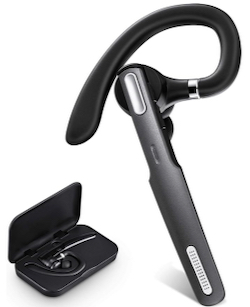
Wireless Bluetooth Earpiece V5.0 Hands-Free Earphones
Bluetooth Headset Wireless with Battery Display Charging Case
“A Deadly Wandering” Distracted Driving Book
(Amazon affiliate links/ads)
2022 distracted driving notes:
Researchers found rear-end injury crash rates dropped 11 percent in Washington after enactment of the state’s hands-free law. The Insurance Institute for Highway Safety said the study found strong distracted driving laws reduced rear-end crashes in two of three states (Washington and Oregon).
Distracted driving legislation (2019-20):
House Bill 1256: Would double penalties for distracted driving offenses in school zones, playgrounds and crosswalks. Approved by the House in a unanimous vote of Feb. 18. Approved by the Senate Transportation Committee on March 2 as SHB 1256. Back to the House. (Lovick)
2021 distracted driving notes:
The vice chairwoman of the Senate Transportation Committee apologized for joining a video conference call while driving. She also was wearing ear buds. State Sen. Rebecca Saldaña said after the April 6 incident: “I have supported legislation about penalties for distracted driving, and like all drivers in Washington state, I must be subject and accountable to that law and all traffic laws.”
2020 distracted driving notes:
A bill seeking to double penalties for use of personal electronic devices in school zones and crosswalks was unanimously approved by the House and advanced in the Senate, but petered out. First-time offenders would have paid a base fine of about $237 under the plan from Rep. John Lovick. “If we can’t keep children safe, then nothing else we do in this world is going to matter,” Lovick told lawmakers in February 2020.
The Washington Traffic Safety Commission pointed to a decrease in distraction-related deaths since 2016. In that year, the WTSC said, 155 people died in crashes linked to distracted driving. In 2019, 33 fewer distracted driving-related deaths occurred. The WTSC credited the Driving Under the Influence of Electronics Act of 2017. “The data shows that Washington culture around distracted driving is changing,” a commission spokesman said in early April.
2018 distracted driving notes:
The overall distraction rate for Washington drivers fell in 2018 to just over 8 percent, according to the state’s annual observational study. There was a dramatic drop in the number of drivers reported using cell phones, to 3.4 percent. That’s down from 5.7 percent in 2017. Cell phones are behind just over half of the distractions on the roadways, the study found. The rewritten distracted driving laws “seem to have had immediate effect on driver behavior,” researchers suggested.
King County’s distracted driving rates decreased from 10.2 percent to 7.0 percent in 2018, according to the state Traffic Commission’s observational study.
State parents are the most likely people to break Washington’s distracted driving laws, a survey by AAA Washington suggests. Of the most common illegal activities, parents with children living at home led the pack in breaking the law, the survey said. Most frequently cited were “setting navigation while driving” and reading a text message. AAA surveyed 1,160 Washington drivers for the November report.
The Washington State Patrol said it handed out 6,400 warnings for cell phone use between the time the new law went into effect in mid-July 2018 and the end of the warning period in mid-January. The patrol said that during the first 12 months of the state’s E-DUI law, there was a 5.5 percent fall in distraction-related crashes.
Distracted driving legislation (2017-18):
Senate Bill 5289: Would rewrite distracted driving law to bar holding of personal electronic devices while driving unless they are in hands-free mode. Cites a list of potential smartphone functions such as composing texts, taking photos and viewing videos. Allows “minimal use of a finger to activate, deactivate, or initiate a function of the device.” Reclassifies offenses as moving violations. Fines doubled for serial violations. Establishes offense of “driving dangerously distracted,” but with secondary enforcement and fine of $30. Takes effect Jan. 1. Approved as SSB 5289 by the Transportation Committee on Feb. 21. Approved by the full Senate in a 36-13 vote of March 6. Amended and approved by the House in a 63-35 vote of April 12. (Changed to make first offense not reportable to insurance.) Amended and approved again by the House in a 61-36 vote of April 19. (Effective date now Jan. 1, 2019.) Approved again by the Senate in a 39-10 vote of April 19. Signed into law by the governor May 16. Takes effect July 23. (Rivers)
House Bill 1371: Companion to SB 5289, above. Approved as SHB 1371 by the Transportation Committee on Feb. 15. Approved by the House Committee on Transportation on April 4. Approved by the full House in a 52-45 vote of March 7. (Farrell)
(text continues)
2017 distracted driving notes:
Gov. Jay Inslee vetoed the part of the Driving Under the Influence of Electronics Act that set a 2019 start; it went into full effect July 23. The Washington State Patrol said it will allow a six-month warning period, but other law-enforcement agencies are writing tickets right away.
Sponsored by state Sen. Ann Rivers and Rep. Jessyn Farrell, the 2017 act did a write-through of the distracted driving laws, which had fallen behind the times. The law now focuses on the holding of personal electronic devices, but allows “minimal” interaction to turn on some functions such as GPS.
Shelly Baldwin, legislative liaison for the Washington Traffic Safety Commission, says there is “just a swirling vortex of people who want” to see a distracted driving law update to succeed in 2017. House Transportation Committee Chairwoman Judy Clibborn told the Seattle Times an update law had better chances of success because lawmakers are more familiar with the issue.
Both Rep. Jessyn Farrell and Sen. Ann Rivers saw their distracted driving measures advance but ultimately fall short in recent years.
Washington state troopers handed out 1,564 citations for cell phone-related infractions last year.
Washington’s Traffic Safety Commission says the previous distracted driving laws were groundbreaking a decade ago, but outdated today. The previous state law barred text messaging but “doesn’t preclude you from looking at Facebook or the Internet as you’re driving,” said director Darrin Grondel.
2016 distracted driving notes:
A roadway worker has died a half year after being hit by an alleged distracted driver. Cody Meyer, a flagger, died May 24. The driver reportedly admitted to making phone calls and checking for messages before hitting Meyer, 23. The driver, Andrew Richwine, faces a vehicular homicide charge.
State Rep. Jessyn Farrell filed legislation to update the distracted driving law. Her HB 2574 would have doubled fines for repeat offenders, but that provision was removed in committee. The Farrell plan bars reading or entering data into a handheld communications device, and so would cover many uses of smartphones, such as accessing social media.
2016 distracted driving legislation:
House Bill 2574: General rewrite of state distracted driving law. Would prohibit a driver from reading or manually entering data on a handheld communications device. Doubles fines for serial offenders. Specifies that first offenders are not to be reported to insurance companies. Adds distracted driving questions to driver’s exam. Allows for device use at stop lights, in self-driving vehicles and allows some uses by commercial drivers. Approved by the House Transportation Committee (as substitute) on Feb. 9. Retained for special session. (Farrell)
2015 distracted driving legislation:
(Substitute) Senate Bill 5656: Would prohibit use of handheld communications devices while driving to include most forms of electronic data manipulation. Doubles distracted driving fine for serial offenders (within five years). Would supersede any local laws. Adds distracted driving questions to driver’s exam quiz. Would take effect Aug. 1, 2015. Approved as substitute bill by the Transportation Committee on Feb. 27. Approved by the full Senate in a 35-14 vote of March 10. Died in House Transportation Committee as vote deadline passed. (Rivers/Transportation Committee)
2015 distracted driving notes:
Cell phones were linked to 521 crashes in 2014, the State Patrol reports.
The Senate voted March 10 to expand the electronic distracted driving laws to outlaw most forms of data retrieval and transmission by handheld devices. But the House Transportation Committee’s deadline for a vote came and went, and the legislation is dead for the year. The panel’s chairwoman said the votes weren’t there for the bill.
State Sen. Ann Rivers wrote the original bill. “We have to do something to send a message that we value traffic safety,” says Rivers, sponsor of legislation updating the state’s distracted driving law, which dates back to 2007. Senate Bill 5656, introduced in late January, used language that covered smartphone activities such as accessing social media and using email.
No one spoke against the bill at a hearing Feb. 9, but representatives for AT&T asked that the bill be clarified to ensure drivers could still make hands-free calls.
In Seattle, police handed out 2,249 tickets for handheld cell phone violations in 2014. That’s on top of 99 tickets for texting & driving.
State Sen. Ann Rivers, sponsor of the 2015 distracted driving overhaul, says: “People need to just hang up and drive, or not text and drive, or not look at their email and drive. It’s really a lot about sending a public message and waking people up.”
One goal of the Rivers-sponsored legislation is to bring Washington state in line with federal DOT guidelines “to ensure that the maximum amount of federal funds” are available for safety programs about distracted driving.
2014 distracted driving notes:
Read a report on the push for new Washington distracted driving laws.
The state Traffic Safety Commission posted an online video featuring footage of officers making traffic stops while trying to enforce the texting law. One driver says she was entering GPS data; another guy says he was viewing currency-trading info. Not texting. Officers say their hands are tied under the current law. View the Washington state texting video.
An attempt to update Washington’s outdated distracted driving laws failed in the Senate last session. It was sponsored by outgoing state Sen. Tracey Eide. “There’s a stakeholder group supporting SB 6227 and they are searching for another senator to reintroduce the bill next year,” her executive assistant told HandsFreeInfo in mid-October.
Distracted driving restrictions are losing a supporter with the retirement of state Sen. Tracey Eide, who won’t be running for re-election for the new biennium legislative term. She served in the legislature for 18 years. The Federal Way Democrat “may be remembered most for her successful efforts to keep drivers from texting and phoning on state roads,” the News Tribune said.
The Washington State Patrol supports the legislative push to update the distracted driving laws. “The problem is holding the phone,” WSP spokesman Bob Calkins told the Olympian. “When you’re driving, you should be driving — not checking your email, not checking Facebook, not texting.” The interest in updated Washington state distracted driving laws is inspired, in part, by a desire for federal funding that would support safety education programs. The state is not eligible because of the outdated wording, which simply bans text messaging and the holding of cell phones to the driver’s ear.
State Sen. Tracey Eide previously pushed through the laws that made text messaging and holding a cell phone while driving primary offenses. She tried again, unsuccessfully, in 2014 with with legislation that would bar drivers from holding wireless communications devices in any way. The restriction would have applied to any use in roadways, including while temporarily stopped at red lights or stop signs. Eide’s plan also sought double fines for serial offenders. A second conviction within five years would have brought a $248 fine. “You being behind the wheel of a car scares the heck out of me when you’’re using these devices,” Eide told NW News. This is Eide’s last term.
The State Patrol handed out 1,216 texting citations in 2013.
Distracted driving legislation (2014):
Senate Bill 6227: Would specify that drivers may not hold wireless communications devices. Includes temporary stops while at red lights or stop signs. Would double fines for repeat offenders of electronic distracted driving laws, to $248. Applies with second conviction within five years. Mandates distracted driving questions on license exams. Numerous miscellaneous changes to distracted driving statute. Died in the Senate. (Elde)
2013 distracted driving notes:
An observational study of drivers in Washington found that 8 percent were busy with cell phones or similar electronic devices. About half of those were text messaging while driving.
The study totaled observations of 7,800 drivers at intersections in King, Snohomish, Pierce, Spokane, Yakima and Whatcom counties. One in 12 were distracted by electronic devices, said Beth Ebel, head of the public safety study, conducted in summer 2012. Ebel said in September: “These findings suggest that distracted driving is more common than we thought and that texting has become a major cause of distraction.”
Ebel, a medical doctor, said the Washington distracted driving study was needed to measure progress in the three years since drivers’ use of handheld devices was banned in the state. It is part of a broader state study of the effects of law enforcement on electronic distracted driving.
State troopers cited more than 1,000 drivers in 2012 for texting while behind the wheel. More than 6,600 others were ticketed for gabbing on handheld cell phones — meaning the devices were used without a hands-free feature or attachment.
The Washington State Patrol says drivers who are poking along in traffic because they’re busy text messaging are clogging the state’s roads and highways.
The WSP said backups caused by texting drivers “impede traffic, frustrate other drivers, and impact the state’s economy by interfering with freight mobility.” The “guidance” of July 15, 2013, was unusual in that the State Patrol admitted it didn’t have data to back up its concerns, but felt strongly enough about its observations to issue the alert.
“You and I are sitting in traffic, going nowhere, because someone ahead of us was texting,” said WSP Chief John Batiste. “We think texting is a factor in far more of these minor collisions than we’ll ever be able to prove.”
Many law enforcement agencies in the state cracked down on electronic distracted driving between May 20 and June 2. The sweep in Spokane, Whitman, Pend Oreille and Ferry counties is supported by Washington’s Target Zero vehicle safety campaign. Officers will be looking for drivers who text message or use handheld cell phones. Last year’s crackdown netted 1,059 cell phone tickets.
The Washington State Patrol says it isn’t sure how many texting while driving collisions are occurring, since typically they cause only minor property damage. “We do not have the legal authority to get search warrants for cell phone records in cases of minor collisions,” WSP Chief John Batiste says. “Our priority in those cases is to get traffic moving again.”
No significant distracted driving legislation was filed for the 2012-2013 sessions. One successful 2013 bill clarifies that commercial drivers cannot use handheld devices or text message while temporarily stopped — as in at a traffic light — but must pull to the side of the road.
The Metropolitan King County Council has created the traffic offense of “inattentive driving.” It went into effect with the new year. The state already prohibits most forms of electronic distracted driving, but the county law adds activities such as eating, wrangling children, putting on make-up and eating.
The King County law calls for secondary enforcement and fines of $124. It was approved Nov. 5, 2012. Distracted driving killed 122 people in King County between 2004 and 2008, safety researchers reported. Seattle is the county seat.
2013 distracted driving legislation:
House Bill 1752: Specifies that drivers cannot use handheld devices while stopped temporarily, but must be pulled to the side of the road. Brings state distracted driving laws regarding commercial drivers into compliance with federal regulations. Approved by the Senate in a unanimous vote of April 15 and by the House in a unanimous vote of March 5. Signed by the governor May 14. (Licensing Department request)
Senate Bill 5847: Would establish that distracted driving data collected in accident reports cannot be used in legal actions against government bodies. (King)
SB 5590: Companion bill to HB 1752, above. Approved by the Transportation Department on Feb. 21. Extended into the special session. (Elde)
Washington cell phone, texting notes (2012):
Washington’s upgrade to primary enforcement has been good for the traffic ticket stats: The number of distracted driving citations is more than five times as high since the law changed, the Highway Patrol said. That’s 6,850 tickets from mid-June 2010 to mid-May 2011, compared with 1,344 in the same stretch of time beginning in 2009. Texting and using handheld cell phones have received primary enforcement since June 2010.
The Washington Traffic Safety Commission says 1,300 crashes were linked to electronic distracted driving from 2006 to 2010. Between 2004 and 2008, distracted driving in Washington State contributed to 758 deaths. In the period 1998-2007, 18 percent of fatal crashes were blamed on “inattention.” The commission points out that collision data collected by crash investigators significantly underreports driver distraction.
2012 distracted driving legislation:
House Bill 2736: Would separate commercial and “noncommercial” drivers with regard to text messaging law. Specifies that the driver of a commercial motor vehicle can text while pulled off to the side of the road with the motor on or off. Defines texting as a “serious traffic violation.” Amended and approved by the House Committee on Transportation on Feb. 6 (amendment removed exemption for some school bus drivers). Approved by the House in a 95-0 vote taken Feb. 11. “Reintroduced and retained” April 11 but not approved. (Department of Licensing via Hansen)
Senate Bill 6534: Companion bill to HB 2736, above. (Department of Licensing via Eide):
2011 legislation:
HB 1103: Revises wording of state prohibitions on video devices in vehicles. Ban would apply only to use of video devices visible to the driver, with the exception of live images of vehicle backing up. Approved by the House in a 90-3 vote on Feb. 22, and then amended and approved by the Senate in a 48-0 vote April 1. The House concurred April 18 (97-0) and the bill was signed by the governor May 16. Law took effect July 22, 2011. (Kristiansen)
2010 legislation:
Washington State Senate Bill 6345: Would make text messaging and holding a cell phone to the ear while driving primary offenses, toughening the existing state law. Also would prohibit drivers with instruction permits or intermediate licenses from using cell phones or text messaging. Fine of $124. Companion bill to HB 2635, below. Approved by the state Senate on Feb. 5, 2010, and then by the House Transportation Committee on Feb. 24. Approved by the full House on March 3, but without the primary enforcement status for adult cell phone violations. On March 6, the Senate rejected the House’s watered-down version of the bill and sent it back to representatives. The House agreed to the Senate’s version on March 11 and the measure was signed Gov. Chris Gregoire on March 26. Latest action: Primary enforcement of the Washington state distracted driving law began June 10. (Eide)
Washington State House Bill 2635: Companion bill to SB 6345, above. Fine of $124. Heard in House Transportation Committee on Jan. 18. (Carlyle)
Washington cell phone, texting notes (pre-2012):
Texting and using handheld cell phones while driving were targeted with primary enforcement as of June 10, 2010. The Washington state House and Senate butted heads over the plan to toughen existing distracted driving laws, but the measure finally was approved and signed by the governor.
An insurance company poll of Washington state drivers found 83 percent supported the current $124 fine for texting while driving or thought it should be higher. Only 11 percent thought the fine was too high. The poll by PEMCO reported that up to 80 percent of the state’s drivers are unaware that distracted driving tickets are not part of their driving records. “Perhaps that’s not a bad misperception, if it discourages almost half of all drivers from texting and talking,” a PEMCO spokesman said Aug. 18.
Drivers ticketed for handheld cell phone use in the three weeks after the new law took effect could be in for a dismissal and refund. The fault lies with the Washington State Department Of Licensing, which failed to update its register of motor traffic laws. Affected jurisdictions include Federal Way, Olympia, Bremerton, Puyallup and Lacey. Tickets issued there between June 10 and July 1 (2010) are eligible for dismissal upon request by the driver.
The Washington State Patrol said it issued 670 tickets to distracted drivers in the 20 days after the tougher penalties went into effect June 10, 2010. Cell phone use brought 633 tickets and texting resulted in 34. About 500 warnings also were issued in that period.
The 2008 distracted driving law has lowered the number of accidents attributed to handheld electronic devices, the State Patrol says.
State Sen. Tracey Eide, D-Federal Way, saw her bill approved by the Senate and House, but the upgrade to primary enforcement for violations of the adult cell phone ban initially was defeated in the House. Representatives reconsidered on March 11 and the plan went to the governor, who signed it March 26.
“I’ve fought for this for 10 years, and sometimes I thought this day would never come,” Eide said after the bill cleared the Legislature. “Maybe now people will pay attention to their driving instead of their conversations.”
Eide led the Senate in rejecting the House’s new version, in an unusual Saturday session March 6.
After the Senate passed SB 6345, she said: “It’s becoming an epidemic, people are not paying attention, and it’s extremely serious.” The vote was 33-15.
Eide sponsored the state’s 2008 hands-free law for cell phone use.
In 2009, more than 1,600 tickets were written for violations of the handheld cell phone ban, the state patrol said. About 230 people received tickets for texting while driving.
Eide’s bill also would cover primary enforcement for text messaging while driving and eliminate cell phone use entirely for drivers with learners permits or intermediate licenses. has the companion bill, HB 2635.
During SB 6345 debate in the Senate Transportation Committee, a student crossing guard testified as to the dangers of his job due to adult drivers distracted by their cell phones.
“Studies show that texting drivers are as dangerous on the road as drivers with a blood-alcohol level of .16 — twice the legal limit,” Eide said in a statement. “When you consider that two-thirds of teen drivers say they text and drive, we’ve got a critical public-safety issue on our hands. We need to strengthen our laws.”
In testimony before the House Transportation committee on Jan. 18, HB 2635 sponsor Rep. Reuven Carlyle, D-Seattle, said: “In Washington state, 97 percent aware (driver cell-phoning and text messaging are) against the law, but it is flouted because it’s a secondary offense.” State Patrol Chief John Batiste testified in favor of the bill, likening the offenses to drunk driving.
The text-messaging ban went into effect Jan. 1, 2008. The hands-free law became effective July 1, 2008, the same day as California’s heavily publicized cell phone driving law.
The fine for using a cell phone without a hands-free device is $124, but drivers must have committed another infraction to get that ticket. (See 2010 legislation, above.)
One year after the cell phone driving law took effect, the State Patrol reported these numbers: 4,939 drivers were stopped for use of handheld cell phones and 1,659 were ticketed. The majority of stops resulted in warnings. For text messaging, the State Patrol said 577 drivers were pulled over and 221 tickets were written. The number of collisions attributed to use of handheld devices fell from 1,118 (2007) to 827.
The 2009 Legislature adjourned on April 26, 2009. No bills concerning cell phones or text messaging were considered.
Washington state drivers’ attitudes about the cell phone driving law are being tracked by the insurance company PEMCO. In February 2008, before the law went into effect, a poll of drivers found that 60 percent of them believed motorists’ use of a handheld cell phone should be a primary offense. Three months after the law took effect, 50 percent replied that should be a primary offense.
“Perhaps not surprising, younger drivers are significantly more likely than their older counterparts to prefer that the law remains a secondary offense,” the PEMCO pollsters reported. “For their part, younger drivers are also more likely to admit that they talk on the phone only if they don’t see a law enforcement person nearby (19 percent versus 4 percent).”
Texting law leader: Washington was among the first six states to outlaw text messaging while driving. As of summer 2009, 14 states have adopted texting bans for motorists.
The prohibition of using hands for cell phone use while driving was signed by the governor in May 2007.

Police officers should follow the same law as everyone else.
Is the Cell phone law the same as the Texting law? Just asking because I took the knowledge test a few weeks ago and it asked a question about texting, the answer I chose was the “texting law” but I got it wrong… I failed the test and am about to take it again this week but I just wanted to be sure about it because even the handbook doesn’t clarify it :/
Got a ticket this week. I was listening to a message. took about a minute. However, when I pulled over, two kids that looked to be about 15 came up and got my information. I never saw an officer with a badge. I was pretty confused. They didn’t really want to talk with me at all. No warning ticket. They just went back to the car and filled out the ticket. My question is: is that even legal? I guess another officer had to be present, but I never saw them.
I got a ticket for texting when I had my cell phone on my leg yesterday sitting at the driveway of a bank waiting to pull out in to traffic. My son texted me which buzzed my phone. I looked down at it then back up to traffic to pull out and a cop pulled me over for texting. He told me looking down was distracted driving, however the ticket issued was texting when I hadn’t texted.
I live in Washington.
The latest SB on this that I’ve read through does not call out an exception for FCC licensed Amateur Radio Operators, unlike all prior state legislation & RCW. Amateur Radio operators have long been recognized for their services providing emergency communications during disasters (floods, storms, earthquakes, etc). Frequently the communications systems for professional first responders become inoperable during power outages, natural disasters, and even large public events (parades, etc). Search And Rescue personnel are particularly in need of the communications services they receive from such amateur radio volunteers, as there is no other alternative in our rural and mountainous areas. Today the largest percentage of amateur radio operators provide such public services.
WA state governors have regularly issued proclamations in support of such licensed amateur radio operators. They MUST be able to operate their equipment legally while driving without confusion on the part of law enforcement, and our courts. Otherwise our public citizens will be placed at a significantly higher risk of danger, even life-threatening situations. Any additional legislation on distracted driving needs to continue the legacy of carving out an exception for amateur radio operators.
Will the new law still contain the exception for drivers with hearing aids?
Until all police departments get on the ball poeple will use their cell phones. City cops, sheriff departments totally don’t ticket drivers. I see fifty to seventy poeple, both teens and adults driveing aruond the streets openly useing their phones for texting and talking. Raise the fines, report them to insurance companies.
Thanks for this very informative article. I know that from a personal standpoint there has been a lot of confusion on the amateur radio issue. Another interesting note, is that amateur radio operators were originally included in the bill until they started to raise awareness and then were excluded. The main reason being that Ham radio provides Emergency communications in practice and in the real world through the ARES organization. Thank you for clearing this up and 73 tu.
I believe the fine should be higher than $124 and that more stops are made by police. I still see far too many people talking, texting it’s difficult to say. Insurance should raise premiums or cancel policy holders that cause harm to anyone if distracted by cellphone use.
I see more police driving and talking on cell phones, I was told by a local Police Dept. That they are allowed so they can communicate with the desk, is this true? I thought that’s why they have a radio and desk officer.
The law as written does not recognize the true danger time in using cell phones while driving. It forbids talking with it to your ear, but it explicitly permitts you to key in a number, The reality is that the only time in the whole process that your eyes are not on the road is when keying. Talking is easy, we do it all the time, “dailing” requires we look down to the phone, not the road.
By the way, GPS use has the same problems while fiddling with the device.
This is truly an ignorant piece of law writing since it does not address the true source of the problem. Go back and do your homework !
All you have to do is sit in traffic at a stop light in Issaquah and watch the one out of three drivers try to make left hand turns while talking on a hand held phone to realize that the Washington state law on hands free use is not only not working but people are literally thumbing their noses at the law. A few sting ops at intersections with tickets written instead of warnings might stop this kind of crap. PLEASE FIND SOME WAY TO ENFORCE THIS LAW!!
what about using phone camera?
Randy: The law seems to prohibit use of cell phone cameras by teenage drivers, but allow use by adults. It would be up to the cop and the judge to determine if you are in violation of the letter of the law … certainly you’d be in violation of the spirit of the law. Read the distracted driving bill modifications approved by the Washington Legislature (several links on the page).
I have read in our local paper Wenatche World that people with hearing aids may talk on their phone going down the same highway that I drive on. Is this true? Also what about those truck drivers going 75 mpr down the same highway using their CB radio’s? Whats the deal with them. So can I have a CB radio and talk on it as I’m going down the highway or street or avenue?
Just thinking out loud. but I would like to know the answers to these questions.
I read a comment somewhere from a CB’er who said that they lobbied hard to allow the usage of CB radios and related equipment. In as much as that sounds bad, I think it’s important to make the distinction that CB radios generally are placed up high, on the dash or attached near the top of the windshield and CB’ers are generally keeping their eyes up at all times.
The main issue with cell phone usage is looking down, trying to find icon buttons to push, or basically trying to mess with the phone in any way which completely removes one’s mind from the road.
Whereas a CB if it’s placed high does not interfere with the driver’s concentration on the road. I don’t use a CB personally, but I think “eyes up” is the big deal here for all devices in a car.
Anyone can get a decent cell phone holder that places the phone near the steering wheel which keeps the eyes up and hands on the wheel. Simply keeping one’s eyes up and hands on the wheel is a big deal.